The Graphic Design Hiring Guide: What Both Sides Get Wrong in 2026
Hiring a graphic designer in 2026 isn't the same as it was five years ago. The tools have changed. The expectations have shifted. And yet, the same fundamental mistakes keep being made — by employers who don't know what good design actually costs, and by companies that treat designers like order-takers instead of strategic partners.
I know this because I'm a graphic designer who has been on both sides of the hiring table. I've hired fellow designers for projects. I've been hired (and sometimes badly) by clients who had no idea what they actually needed. And I've watched countless designers and employers talk past each other because nobody established a shared language for what "good" looks like.
This guide is the conversation I wish every employer and every designer had before signing a contract. No fluff. No generic "10 tips for hiring designers" listicles. Just the actual mechanics of how graphic design hiring works in 2026 — and how to do it without wasting time, money, or talent.
Why Graphic Design Hiring Is Broken in 2026
Here's what actually happens when a non-designer tries to hire a graphic designer: they post a job listing, get 200 resumes, skim a few portfolios, pick someone who "looks professional," hand over a vague brief, and then wonder why the final output doesn't feel right.
The problem isn't that good designers don't exist. The problem is that most hiring managers are evaluating aesthetics when they should be evaluating thinking.
A portfolio full of beautiful work tells you one thing — the designer can make things look good. It tells you nothing about whether they can solve a business problem, communicate under feedback pressure, or deliver files that are actually production-ready.
On the flip side, many designers sabotage themselves by submitting to every gig that pays, taking on scope they never clarified, and then burning out when the revisions never stop. They never asked the hard questions upfront because they were afraid to lose the job.
Both sides lose because neither side communicated.
The good news: this guide fixes that. Read it before you post a job listing. Read it before you send your next portfolio. It's 2026. The old playbook doesn't work anymore.
Step 1: Define What You Actually Need
Most hiring disasters start here — before anyone has exchanged a single email.
Before you look for a designer, answer these questions honestly:
Are you hiring for production or strategy? A production designer executes: logos, social graphics, print layouts, ad variations. A strategic designer contributes to brand decisions, campaign thinking, and creative direction. Most small businesses need production. Most growing brands need both. Know which one you're buying.
In-house, freelance, or agency? An in-house designer learns your brand inside-out and becomes a long-term creative partner — but they're a fixed cost whether you're producing a lot or a little. A freelance designer is flexible and cost-efficient for project work, but requires more management and isn't always available for quick turnarounds. An agency brings a team with diverse skills, but at agency prices. Each model fits a different stage of growth.
What does success look like? "Make it look good" is not a brief. Neither is "I know it when I see it." Before you reach out to anyone, define what the work needs to accomplish. Who is the audience? What should they feel or do after seeing it? What existing brand assets must it respect? Write it down. This is your brief. A clear brief is the single biggest predictor of a successful hire.
Tip: The most expensive mistake in graphic design hiring isn't overpaying. It's hiring the right designer for the wrong project — and then trying to make them do something they never signed up for.
Step 2: Where to Find Designers in 2026
Knowing where to look is half the battle. Designers don't all live in the same places. The platform you choose shapes the type of designer you'll find.
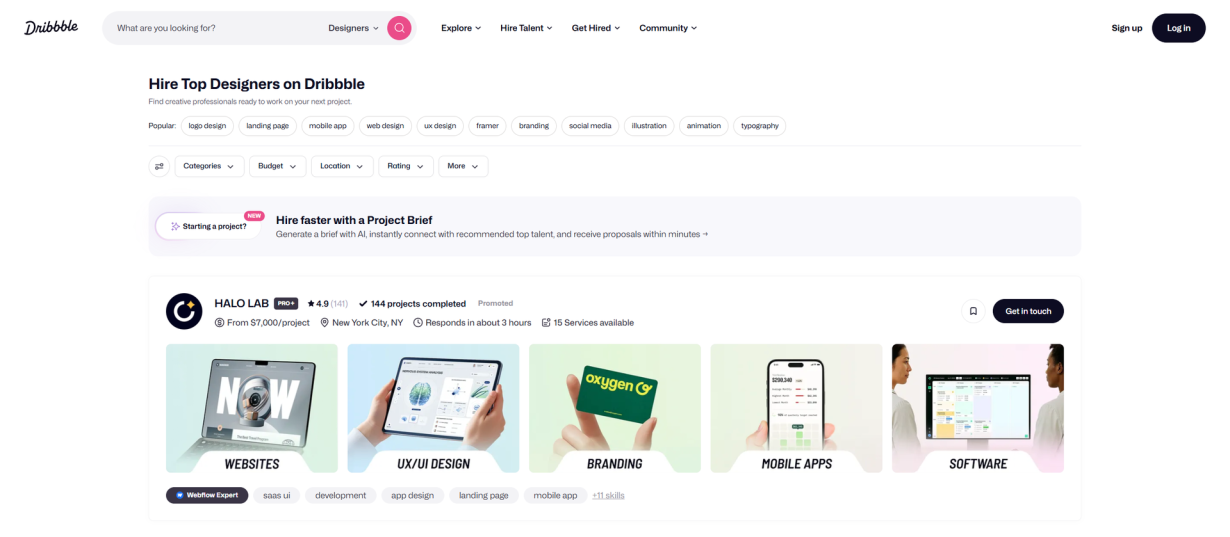
Dribbble and Behance are where professional designers showcase finished work. If you want to see a designer's aesthetic range and visual craft, start here. Dribbble is stronger for digital/UI-adjacent work; Behance has deeper case studies from branding and print designers. Expect to do more vetting work here — portfolios don't always tell you about process, reliability, or communication style.
Toptal vets its designers rigorously before listing them. You'll pay a premium, but the quality floor is higher and the matching process is more intentional. Worth it if you need someone fast and can't afford a bad bet.
Upwork and Fiverr offer broad access to designers at every price point. You can find talented people here, but the vetting burden is on you. Look carefully at client reviews, response time, and portfolio consistency — not just the portfolio itself.
Direct outreach is underrated. Find designers whose work you genuinely admire on social media or their personal sites, and reach out directly. Many strong designers aren't actively job-hunting but are open to interesting projects. This is how you find the best fits, not just the most available ones.
LinkedIn and design communities are good for finding designers with specific industry experience or niche specializations (packaging, illustration, motion, etc.). Designer communities on Slack and Discord also exist for specific niches.
The platform matters less than your vetting process. A great designer on Upwork beats a mediocre one from an expensive agency every time.
Step 3: How to Read a Portfolio Like a Hiring Pro
Here's the portfolio review checklist I use when I'm hiring — whether I'm looking for a collaborator on a large project or a specialist for a one-off piece. Most non-designers don't know what to look for. This is what to actually pay attention to.
Consistency over peaks. One stunning piece means the designer can make one stunning piece. Look across the entire portfolio. Does the quality hold across 10 projects? Are the typography choices consistently refined? Does the color usage feel intentional or accidental? Consistency is harder to fake than a single great portfolio piece.
Problem-solving evidence. The best portfolios show not just the final output but the thinking behind it. Does the designer show sketches, iterations, mood boards, or process documentation? This tells you whether they design by intuition or by method. Designers who can explain their decisions are the ones who can take a vague brief and turn it into something brilliant.
Versatility vs. jack-of-all-trades. Can the designer work across different styles, or do they only have one mode? Versatility means they can adapt to your brand. A one-note portfolio is a red flag unless your brand happens to match their single note exactly.
Live links over mockups. If all the work is shown as device mockups and stock-style presentations, ask to see live websites, published campaigns, or real-world applications. Mockup-only portfolios can hide sloppy execution.
Relevance to your industry. A designer who has done ten restaurant rebrands might not be the right fit for a B2B SaaS brand. Not always — some designers are generalists who adapt quickly — but it's worth asking yourself whether their existing body of work signals the right instincts for what you need.
Red flag: If a portfolio has no dates, no client names, and no context — just pretty images — treat it as incomplete. Great designers are proud of their process and contextualize their work.
Step 4: The Interview Questions That Actually Reveal Fit
Most design interviews fail because they ask the wrong questions. "What's your favorite font?" and "What software do you use?" are irrelevant. What you actually need to know is how this designer thinks, communicates, and handles pressure.
Ask these instead:
"Walk me through your process from brief to final file." The answer reveals everything. Designers with a clear process will walk you through research, concept development, client feedback rounds, revisions, and file delivery. Designers without one will give vague answers. A clear process is a sign of professional maturity.
"How do you handle feedback you disagree with?" This is the question that separates professionals from difficult prima donnas. Good answer: they explain their reasoning, present alternatives, and ultimately defer to the client's decision while offering their expert opinion. Bad answer: they get defensive, dismiss the feedback, or promise to "just do what you want." Both extremes are red flags.
"Tell me about a project where the brief was unclear. What did you do?" This reveals resourcefulness and communication skills. Great designers ask clarifying questions when briefs are unclear. Mediocre ones make assumptions and deliver something off-target.
"What's your file delivery process?" Production-ready files are a whole separate skill. Ask whether they deliver in the right color modes (CMYK for print, RGB for digital), proper resolution, and organized layer structures. If they look confused by this question, they may not have professional production experience.
"How do you handle revisions?" This should be in your contract, but the interview is where you get a sense of their baseline expectations. How many rounds of revisions are included? What's the hourly rate for additional rounds? A designer who has thought about this is a designer who runs a professional practice.
Step 5: Trial Projects — The Right Way
The trial project is the most debated step in the graphic design hiring process. Done wrong, it's exploitation. Done right, it's the single best predictor of a successful working relationship.
Here's the rule that most employers miss: if you ask for work, pay for it.
Unpaid "test projects" are the graphic design industry's equivalent of working for free. The community has spoken loudly and consistently on this: if you want to see how a designer works, pay them for a scoped micro-project. A half-day design sprint for a real (but bounded) deliverable tells you everything an unpaid spec test never will.
What's a fair paid trial? Depends on the scope, but for a small brand identity exploration or a social media asset, $150–$500 is reasonable for a scoped piece of work. For a half-day sprint at a mid-market rate of $75–$150/hour, you're looking at $300–$600. That's cheap insurance against a bad hire.
What to evaluate from a trial project:
Communication during the process. Did they ask good questions? Did they update you proactively? Or did they disappear for three days and come back with something off-target?
How they handle feedback. Give them one round of notes and watch how they respond. Do they get defensive? Do they implement the feedback thoughtfully? Do they push back with good reasoning?
Quality of the output. Does it match your brief? Is it production-ready? Does it show creative thinking beyond what you explicitly asked for?
Punctuality and professionalism. Did they deliver on time? Did they communicate proactively when things got complicated?
A good trial project isn't about finding the "best" design — it's about seeing how the designer works as a collaborator. That's what matters more than any single deliverable.
The AI Question: When to Use Tools vs. Hire a Human
This is the question I get asked constantly in 2026, and I'll give you the same answer I give clients: it depends on what you're trying to accomplish.
Use AI design tools (Canva, Adobe Firefly, Midjourney, etc.) when:
You need one-off assets quickly — social posts, internal presentations, rapid concept exploration
The output doesn't need to represent a brand identity, just communicate a message
You're at a stage where you need volume over quality — iterating fast before committing to a direction
Budget is extremely tight and any design is better than no design
Hire a human designer when:
You need a cohesive brand identity that will be used across dozens of touchpoints
The work needs to solve a specific business problem, not just look nice
You're building something that represents your company to clients, investors, or partners
You need strategic thinking — not just execution, but direction
The output needs to be culturally relevant, emotionally resonant, and aligned with a specific audience
Here's the thing most people miss: AI tools and human designers aren't in competition. They're on a continuum. The best design workflows in 2026 use AI for ideation, rapid iteration, and production tasks — and human designers for creative direction, brand strategy, and the work that requires judgment about context, culture, and meaning.
Think of AI as a power tool. It makes the work faster. But you still need someone who knows what to build and why.
Practical framework: If you can't articulate the three or four things the design needs to accomplish, you're not ready to hire anyone — human or AI. Brief clarity comes first.
What Designers Wish Employers Knew
I asked myself this question honestly, and I've heard the same answers from colleagues across the industry. If you're an employer, these are the things designers rarely say out loud — but wish you understood.
A bad brief produces bad work, every time. If you hand over "just make it look professional," don't be surprised when the output is generic. Designers need context to do their best work. Your industry, your audience, your competitors, your goals — a strong brand identity guide ensures they do — this isn't optional information. It's the brief.
Unlimited revisions is not a feature. Scope creep is the number one cause of designer burnout and resentment. Every professional has a defined revision process. Respect it. If you need more revisions, expect to pay for them. This isn't greed — it's basic business practice that protects both sides.
Your opinion of the design is not the same as quality. This one is hard to hear. "I don't like blue" is not a design note. "Our audience research shows blue doesn't resonate with our demographic" — that's a design note. Designers need feedback that's grounded in reasoning, not preference. Preference-based revision cycles go on forever.
We know when we're being used for spec work. Asking for "just a few concepts" before committing to a hire, then taking those concepts and implementing them yourself? Designers see this. And when they do, they start requiring payment upfront — which is the right response. It raises costs for everyone, including good-faith employers.
The best relationships are partnerships. The most successful projects I've been part of came from clients who treated me as an expert collaborator, not a vendor. They gave me context, trusted my judgment, and pushed back with reasoning when they disagreed. Those are the projects I'm most proud of. Those are also the clients who keep coming back.
Graphic design hiring doesn't have to be broken. The fundamentals are straightforward: know what you need, find the right person, communicate clearly, and treat the relationship as a professional partnership rather than a transaction.
Do that, and you won't just get good design. You'll get design that actually works for your business.
Tags
Linh Nguyen
Graphic Designer
Passionate Graphic Designer | Specializing in Illustration Design | Bringing Captivating Visuals to Life