Micro Graphics Design Trends 2026: The Anti-AI Rebellion in Small Details
Here's a sentence I never thought I'd write: the most valuable design skill in 2026 is learning to draw a crooked line.
Not because AI can't draw straight ones — it can, obsessively. But because designers have realized that in a world where anyone can generate a polished interface with a single prompt, the scarce resource isn't polish. It's evidence that a human made a choice. A shaky line. A paper texture. A button that bounces slightly wrong. These micro-graphics (or micrographics) — the smallest design details — have become the battleground where brands differentiate from the AI-generated sea of sameness.
This isn't nostalgia. It's strategy. Here's what's happening at the micro level of design in 2026, and why it matters more than the macro trends.
The Anti-AI Micro-Graphics Rebellion
The numbers tell the story before the aesthetics do. Canva's 2026 Design Trends report — titled "Imperfect by Design" — found that 80% of creators plan to reassert creative control this year, 77% see AI as a partner rather than a replacement, and perhaps most telling, searches for "lo-fi aesthetic" surged 527% year over year. Adobe reports that 73% of designers now deliberately incorporate imperfect elements into their work.
The reason is simple: AI-generated design has produced a visual monoculture. When everyone uses the same models trained on the same datasets, everything converges toward the same aesthetic — soft gradients, geometrically balanced compositions, the abstract-gradient-swirl logo that roughly 62,000 AI startups have independently arrived at. As Graham Sykes, Global ECD at Landor, put it bluntly: "Human-driven craft is the antidote to AI's hyper-slick visual language. Designers are putting hands back on the work — hand-built sets, stitched texture, analogue surfaces, physical collage, ink, fabric, clay."
This isn't Luddism. Most designers are using AI tools daily. The shift is in what they're using AI for — production and iteration — and what they're reserving for human judgment: the small, specific, imperfect details that signal a person was here. The micro-graphics.
The data backs up the instinct. Handmade and tactile design elements drive 67% higher engagement than purely AI-generated work. The question isn't whether imperfection works. It's which kind of imperfection to use.
The Micro-Graphic Styles Defining 2026
Five distinct micro-graphic styles have emerged this year. Each solves a different problem, but all share the same DNA: they look like a human touched them.
Trinket Design — what Kittl calls the archival aesthetic taking over 2026 — treats everyday objects as curated artifacts. Think scanned shells and pressed flowers arranged on specimen-sheet layouts, numbered labels in tiny sans-serif, neutral backdrops with museum-catalog precision. It's scrapbook logic meets scientific illustration, and it's everywhere in indie brand packaging right now — tea, skincare, craft chocolate. The micro-graphic move is the tiny label, the catalog number, the subtle drop shadow under a scanned object that says "this is real."
Scrapbook / Scissor Works is the messier sibling. Letters cut from magazines, torn edges and rough collages, handwritten annotations. Envato reports collage art searches up 19% and bold fonts up 65.7% — the controlled chaos of layered photography, illustration, and type in one composition gives brands a DIY immediacy that polished layouts can't match.
Scribble Core is exactly what it sounds like — deliberately unfinished sketches, pencil marks, unclosed lines, hand-drawn arrows and annotations. Default system fonts paired with crossed-out text and margin scribbles. It looks like the notes you'd make on a draft, except the draft is the final product. The message: this idea is alive, not finalized.
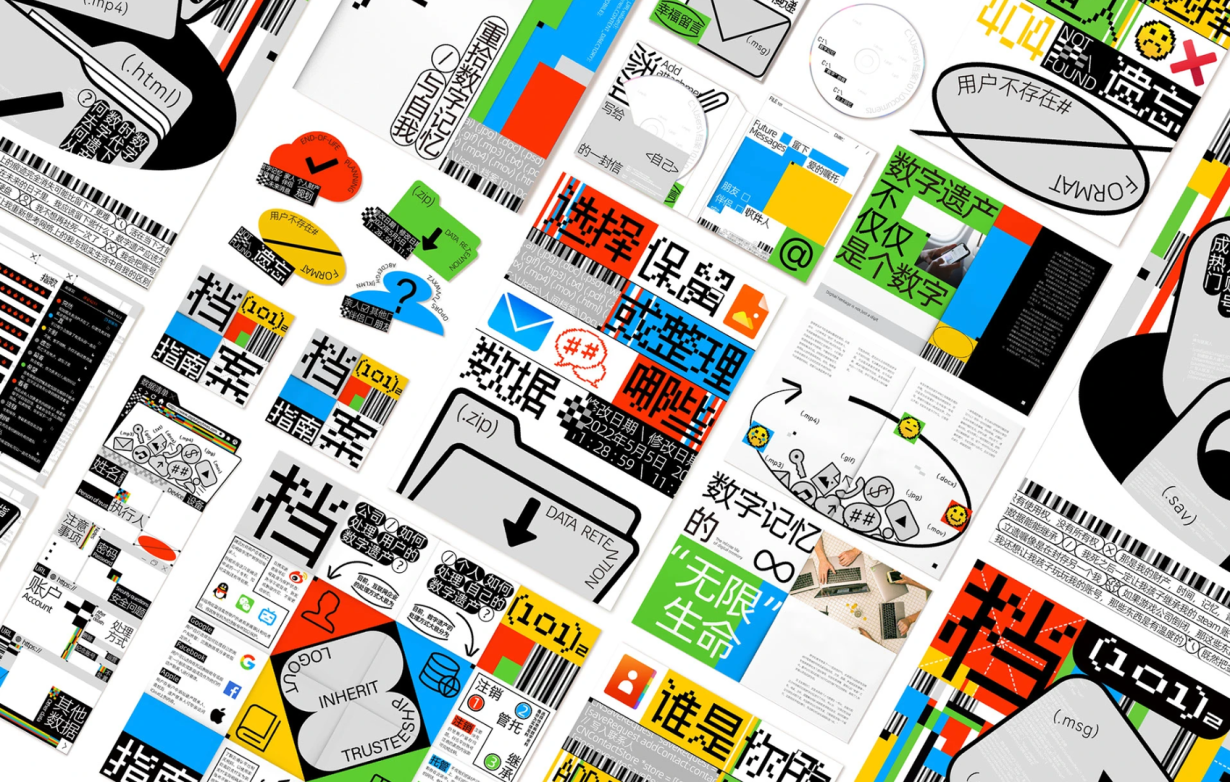
Micro-Industrial — identified by VistaPrint/99designs — puts tiny utilitarian marks front and center: barcodes, QR codes, regulatory icons, technical labels, grid structures. The micro-graphic is the functional mark itself, elevated from information to ornament. It's packaging design's inside joke — "we're showing you the boring parts because we can."
Notes App Chic is the most deliberately un-designed of the five. Screenshot-style layouts, default system fonts, bullet lists, the visual language of "I typed this on my phone." It's carelessly intentional — the anti-design that says "we didn't overthink this" by overthinking it precisely.
These five styles don't compete with each other. Smart brands mix them — trinket labels on scrapbook backgrounds, scribble annotations over industrial grids. The common denominator is the micro-detail: the thing that takes an extra ten minutes to add and communicates that someone cared enough to add it.
Micro-Interactions as Emotional Infrastructure
If micro-graphics are the visible evidence of human touch, micro-interactions are the felt evidence. And in 2026, they've graduated from "nice to have" to functional infrastructure.
The consensus across product design circles is clear: micro-interactions separate products people love from products they tolerate. A button that bounces slightly on press, a card that settles into place rather than appearing, a loading state that communicates personality instead of a spinner — these aren't decorations. They reduce cognitive load. They confirm actions. They build trust in systems that otherwise feel opaque.
Three shifts define 2026 micro-interaction design:
First, motion is now functional, not decorative. Every animation serves a purpose — guiding attention, confirming an action, reducing uncertainty. The days of gratuitous parallax scrolling are over. If a micro-interaction doesn't communicate something, it doesn't belong.
Second, interactions respond to context. Elements react to cursor movement, scroll position, device tilt — websites behave more like environments than flat pages. A card might shift slightly as you mouse past. A gradient might respond to scroll velocity. These aren't gimmicks. They create spatial understanding, a sense of where you are in a digital space.
Third, the motion language borrows from handcraft. Staggered, imperfect animations — elements that don't move in perfect sync. Stop-motion feels, organic easings, collage-style transitions where layers slide at different speeds with visible edges. The animation itself communicates humanity.
This convergence of micro-graphics and micro-interactions — the visible imperfection and the felt imperfection — is where the most distinctive brand experiences in 2026 live.
How Top Brands Are Using Micro-Graphics
The theory is only as good as the execution. Here's what the execution looks like at the top of the market.
Burberry launched a Cross-Stitch Knight Life campaign built entirely on stitched textures and fabric structures — physical needlework digitized without losing the thread. Apple introduced an Apple TV intro with hand-blown glass, zero CGI, every imperfection of the glassblower's process left visible. Madalena Studio literally cultivated bacteria on a cork logo for a fragrance brand, turning microbiology into brand identity.
These aren't stunts. They're bets. Each one says: we spent time and money on something AI can't do, specifically because AI can't do it. The micro-graphic — the stitch, the glass bubble, the bacterial growth pattern — carries the entire brand argument.
The indie space is where the trend is most accessible. Trinket Design dominates craft brand packaging — tea tins with specimen labels, chocolate bars with archive-style numbering, skincare bottles with hand-drawn botanical illustrations. Fontfabric's trend report cites Foccacia Fabbrica and Taresso as leading the "carefully unpolished" brand identity — wobbly outlines, grain textures, risograph effects, deliberate mis-registrations that simulate print imperfection.
The economics are stark. Human-crafted design now commands 10-50x the cost of AI-generated alternatives, according to the Design Magazine Australia analysis of what they're calling the "$50 Million Handmade Rebellion." When algorithmic perfection is infinite and free, visible human labor becomes the luxury marker. The micro-graphic is how you show that labor.
Tools and Techniques for Human-Feeling Micro-Graphics
The practical question: how do you actually make this stuff?
You don't need to hand-stitch a logo or blow glass. The techniques that create human-feeling micro-graphics are surprisingly accessible:
Texture overlays are the entry point. Paper scans, fabric photos, concrete surfaces, ink bleeds — applied with Multiply or Overlay blend modes at 15-40% opacity. A single paper grain layer can pull a vector illustration out of uncanny valley. The key is using real scans, not digital noise generators, because real surfaces have irregular patterns that AI texture tools don't reproduce well.
Noise filters add photographic warmth. Subtle grain — the kind you'd get from a high-ISO film shot — warms digital precision without calling attention to itself. The mistake beginners make is too much noise. If you notice the grain, it's too heavy.
Displacement maps and rough-edge brushes simulate torn paper, ink bleed, and risograph mis-registrations. Slight rotations — elements intentionally 1-3 degrees off-grid — break the mathematical alignment that screams "computer made this."
AI-assisted craft is the workflow most designers are actually using. Generate the base composition with AI tools. Then add the human layer: texture, imperfection, the specific choices an AI wouldn't make. This isn't cheating — it's using AI for what it's good at (production, iteration, variation) and reserving human judgment for what it's good at (taste, specificity, knowing when something feels right).
💡 Tip: The best micro-graphic is the one the AI wouldn't have thought to add. If you're not sure whether an imperfection reads as intentional or as a mistake, make it slightly more visible. The whole point is that someone sees it.
The design tools that make this easy — Kittl for trinket-style layouts, Photoshop displacement maps for print textures, Procreate for hand-drawn elements, After Effects for organic motion — are all mature. The bottleneck isn't software. It's taste. Knowing which imperfection belongs where.
What the Micro-Graphics Shift Means for Designers
Here's the uncomfortable part: AI is getting better at imperfection. The models are learning to generate fake grain, fake brush strokes, fake collage textures. It won't be long before they can fake most of the micro-graphic styles described here.
Does that make this whole movement a temporary reaction?
I don't think so, and here's why. The value of micrographics isn't in the technique — it's in the choice. The specific grain texture, the particular paper scan, the exact angle of rotation. AI can generate a thousand variations of a torn edge. It can't decide which one feels right for this brand at this moment. That decision — the judgment call, the taste — is what the market is paying for.
This is genuinely good news for designers. For years, the anxiety has been that AI would commoditize design skill. What's actually happening is that AI is commoditizing design production — the pixel-pushing, the variation generation, the layout iterations. And it's elevating design judgment — knowing what to make and why — into the primary source of value.
The micro-graphics trend isn't about fighting AI. It's about showing your work. The small imperfections and specific choices are how you prove, to clients and audiences alike, that a person was here — thinking, choosing, caring. In 2026, that's the whole job.
Cover is the design created by lyun9330
Tags
Linh Nguyen
Graphic Designer
Passionate Graphic Designer | Specializing in Illustration Design | Bringing Captivating Visuals to Life