How to Balance Maximalist Textures: A Designer's Framework for Getting It Right
The Maximalist Texture Trap: Why "More" Feels Like "Mess"
Here's a scene every designer knows. You've spent weeks layering a space — linen drapes catch the light, a velvet sofa anchors the room, a jute rug adds warmth underfoot, and hand-thrown ceramic vessels scatter across a raw timber console. You step back, ready to feel proud.
Instead, your gut says: this feels wrong.
The room isn't bad — but it isn't good either. Something buzzes. The textures compete instead of talk. You can't put your finger on why, so you do what most people do: add one more thing, hoping it clicks. It doesn't.
Learning how to balance maximalist textures isn't something design school covers — and it shows. Texture is invisible in photos and wildly subjective in person. Colour has the colour wheel. Layout has the grid. But texture? Most designers are taught to "feel it out," which is just another way of saying guess.
The data says maximalism isn't going anywhere. A 2026 1stDibs survey found demand for maximalist interiors jumped 39% YoY among design professionals. Creative Market named "coarse linen drapery" and "creative chaos" as defining 2026 visual trends, framing them as a deliberate rebellion against "the perfect smooth digital look" of AI-generated design. And Feathr's 2026 trend report pegged "Crafted Maximalism" — pattern-on-pattern, narrative-driven interiors — at +480% growth. As Homedit's 2026 maximalism feature put it: "Bold color, patterned walls, layered textiles, and statement furniture define these spaces."
People want more. They just don't want a mess. This guide gives you a repeatable system for knowing the difference.
The 4-Layer Texture Framework: A System That Works Every Time
After years of getting it wrong and a few glorious moments of getting it right, I've landed on a framework that removes the guesswork. Every successful maximalist space — no matter the style, budget, or room size — balances four distinct texture layers. Skip one, and the room feels off. Stack them all, and it sings.
Layer 1: Foundation Textures
These are the room's backbone — the surfaces that cover the most square footage. Walls, flooring, large-scale upholstery. Foundation textures set the baseline tactility and should feel quietly present, not attention-seeking.
Think: limewash walls, wide-plank oak floors, a linen sectional, grasscloth wallpaper in a neutral tone.
A foundation texture's job is to be interesting up close but recede at a distance. If your foundation texture demands attention from across the room, it's not a foundation — it's a statement piece in disguise, and you now have two competing heroes.
Layer 2: Accent Textures
These are the textures you notice second. They add depth without stealing the spotlight: a boucle armchair, velvet throw pillows, a fluted-wood side table, a nubby wool rug.
Accent textures should contrast the foundation. Matte walls? Add a glossy ceramic lamp. Smooth leather sofa? Add a chunky knit throw. The rule: every accent texture should differ from the foundation in at least one dimension — rough vs. smooth, matte vs. shiny, hard vs. soft.
Layer 3: Contrast Textures
This is the layer most people skip — and it's the one that separates "nice room" from "I can't stop looking at this room." Contrast textures are deliberate friction points. They're the one or two surfaces that feel slightly wrong alone but electrify everything around them.
A raw, live-edge wood bench against polished plaster walls. An unlacquered brass pendant over a velvet dining chair. Cracked, hand-painted Zellige tiles next to smooth marble countertops. Contrast textures work because the eye craves tension — without it, even a maximalist room can feel flat and polite.
Pro tip: If every texture in the room "goes together," you've built a catalogue page, not a maximalist space. Add one texture that makes you slightly uncomfortable. Live with it for three days before you decide.
Layer 4: Breathing Textures
Breathing textures are the negative space of tactility. Smooth plaster walls between busy zones. A solid linen bedspread in a room full of patterned pillows. An empty stretch of pale oak floor.
Breathing textures give the eye a place to reset so the bold textures actually land. Without them, the room reads as noise — every texture shouting and nothing heard. The ratio I aim for: for every three textured surfaces, one should be visually quiet. This is not wasted space. It's punctuation.
Here's the framework applied to two very different rooms:
Layer | Moody Dining Room | Sunlit Living Room |
|---|---|---|
Foundation | Limewash walls (deep charcoal), dark stained oak floors | Warm white plaster walls, pale oak floors |
Accent | Velvet dining chairs, jute rug, fluted wood credenza | Boucle sofa, nubby wool rug, rattan pendant |
Contrast | Unlacquered brass pendants, raw ceramic vessels | Cracked-glaze terracotta planter, blackened steel coffee table |
Breathing | Smooth plaster above the wainscoting, bare wood table surface | Linen curtains, open negative wall space between art pieces |
This framework works across styles — swap the materials, keep the layer logic. Now, how do you know if you've actually pulled it off?
The "Squint Test" and 4 Other Gut-Checks That Tell You When You've Nailed It
Designers love to say "you'll know when it feels right." That's great if you've been doing this for fifteen years. For everyone else, here are five objective tests that don't rely on intuition.
1. The Squint Test
Stand at the room's entry point and squint until everything blurs. You should see one dominant dark zone, one dominant light zone, and a gradient between them. If you see a checkerboard of equal-weight darks and lights scattered evenly, your visual weight distribution is broken. Redistribute one heavy textured piece from the overloaded side to the lighter side.
This works because squinting strips away detail and leaves only mass, value, and weight — the structural bones of texture composition.
2. The Grayscale Photo Test
Take a photo of the room and convert it to black and white. Three things become immediately obvious: where texture is concentrated (dark, dense clumps), where it's missing (flat, featureless grey zones), and whether your contrast textures are doing their job (sharp value transitions). If multiple areas read as the same shade of mid-grey, you've built a room with no hierarchy — every texture is fighting at the same volume.
3. The "Describe It in Three Words" Test
Ask someone who hasn't seen the room to describe it after a thirty-second look. If they say "warm, layered, inviting" — you're there. If they say "busy," "loud," or "a lot going on" — you've crossed into clutter territory. If they say "nice" and nothing else, your textures aren't registering at all, and you need more contrast. The goal isn't a specific set of words; it's that the description matches what you intended.
4. The One-Detail Test
Walk into the room and count how many individual textures your eye lands on in the first five seconds. If it's more than five, the room is reading as noise — your eye can't establish a focal point and is panicking, scanning for a place to land. Three to five is the sweet spot. If you only land on one, the room is too flat.
5. The "Take One Thing Away" Test
Remove one textured item — a pillow, a throw, a ceramic piece. Does the room feel better or worse? Maximalism's dirty secret is that the best rooms are one subtraction away from perfection. If removal leaves a noticeable hole, put it back and remove something else. If removal makes the room breathe, you just found what was tipping the balance. Leave it out for a week before you decide it belongs.
Run all five tests. When they align, trust the result — even if the room feels slightly under-done by your old standards. That slight edge of restraint is what separates curated from cluttered. Once you've diagnosed the problems, you'll need the right material combinations to fix them. Let's start with the pairings that never fail.
Texture Pairings That Always Work (Steal These Combinations)
Some combinations just work. They work because they hit contrast in multiple dimensions at once — rough against smooth, matte against sheen, warm against cool. Here are the pairings I return to across projects, organized by the mood they create.
Warm + Grounded
Boucle + raw oak. The nubby, looped texture of boucle against smooth, wide-grain oak. The wood grounds the fabric's fluff; the fabric softens the wood's hardness. Perfect for living spaces.
Hand-thrown ceramics + aged brass. Matte, irregular clay surfaces next to patinated metal with subtle warmth. The tension is in the finish contrast — one completely matte, one softly reflective.
Linen + jute. Two natural fibres at opposite ends of the refinement spectrum. Linen's soft drape against jute's coarse, ropey texture. Keep them in the same colour family for maximum sophistication.
Moody + Dramatic
Zellige tile + unlacquered brass. Hand-cut, irregular glazed tiles with visible imperfections paired with brass that will darken and develop character over time. Both materials age — that's the point. Best in bathrooms and bar areas.
High-gloss lacquer + heavyweight linen. Deep, liquid-shine cabinetry (think inky navy or aubergine) grounded by thick, matte linen drapes or upholstery. The gloss-linen gap is enormous — and that's why it works.
Textured plaster + dark sculptural wood. Rough, organic wall surfaces against Brutalist-inspired chunky wood furniture. Moody, saturated wall colours (espresso, deep olive) amplify the effect.
Light + Airy
Rattan + crisp cotton. Open-weave natural rattan caning paired with smooth, high-thread-count cotton. The contrast is in density — one airy and perforated, one tight and opaque.
Fluted glass + matte stone. Ribbed, semi-transparent glass surfaces next to honed marble or travertine. Both play with light, but in opposite ways — glass refracts it, stone absorbs it.
Shearling + powder-coated steel. The softest texture in the interior world against one of the hardest. Use it sparingly — one shearling throw over a steel-framed chair is enough.
The One Rule That Governs All of Them
Every pairing follows the same principle: differ in at least two dimensions. Rough vs. smooth is one dimension. Matte vs. glossy is another. Hard vs. soft is a third. Warm vs. cool is a fourth. Boucle + raw oak differs in all four — rough/smooth, matte/matte (both matte, so add a glossy third element), hard/soft, warm/warm. It works because the three dimensions where they do differ outweigh the one where they don't.
When a pairing feels "almost right but not quite," add a third element that introduces the missing dimension. A glossy ceramic vase between the boucle chair and the oak side table bridges the matte-matte gap. That third piece is often the difference between a room that's "nice" and one people photograph. These pairing principles were built for physical spaces — but they translate into digital work in ways that most designers overlook.
When to Break the Rules: Texture in Graphic and Digital Design
As a graphic designer, I'd be doing you a disservice if I didn't talk about how these principles translate off the walls and onto the screen. The 4-layer framework and balance tests were built for interiors, but they map surprisingly well to digital work — and 2026's visual trends are making textured maximalism more relevant in pixels than ever.
The Digital Texture Renaissance
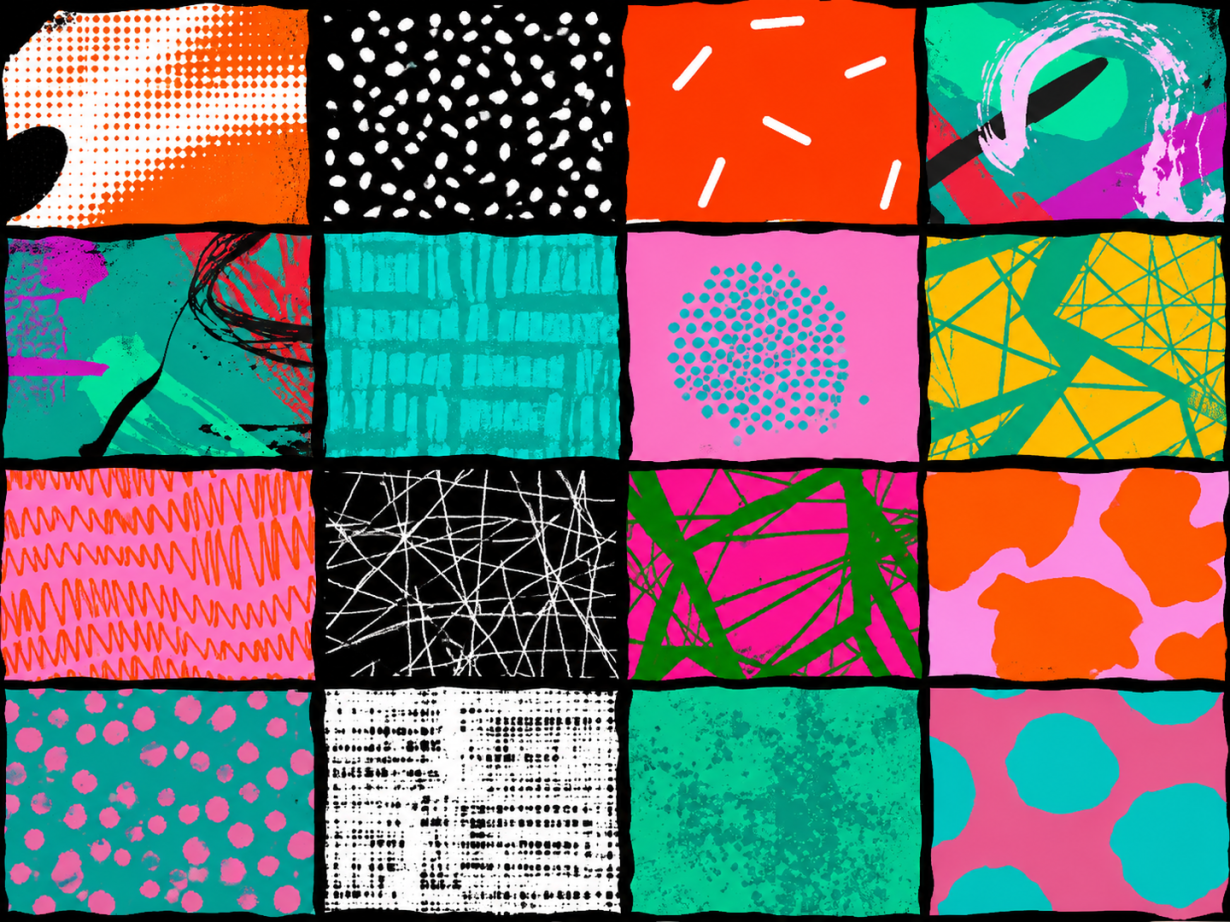
Creative Market's 2026 trend report calls out "creative chaos" — collage layouts, torn paper edges, scanner grain, watercolour washes — as the dominant visual language. Canva named 2026's creative theme "Imperfect by Design," a direct pushback against the hyper-smooth, AI-generated aesthetic that flattened digital design through 2024 and 2025. Searches for "distorted" graphics are up 45%. "Grain" and "noise" are everywhere.
Texture is the breakout star of 2026 because texture is what AI can't convincingly fake — at least not yet.
The 4-Layer Framework, Translated
Layer | Interior Equivalent | Digital Equivalent |
|---|---|---|
Foundation | Limewash walls, wood floors | Off-white or subtly textured background, slight paper grain |
Accent | Boucle chair, wool rug | Duotone photo treatment, subtle halftone overlay, organic blob shapes |
Contrast | Raw-edge wood, unlacquered brass | Scanner grain on one element, torn-paper mask, high-noise photograph |
Breathing | Blank wall, open floor space | Clean typography lockups, solid-colour sections, generous padding |
The squint test works in digital too — blur your screen (or zoom way out). If the composition reads as an even distribution of busy-ness with no clear focal point, you need more breathing space. The grayscale test is built into Photoshop. Use it.
The Trap to Avoid
The biggest mistake I see in digital maximalism is treating every element as a contrast texture. Noise on the background, grain on the hero image, distressed type, collage cutouts, and a textured gradient? That's the digital equivalent of a room where every surface is the star — and nothing lands. Pick one element to carry the grit (usually the hero image or key illustration) and let the rest stay cleaner than you think they should.
The same subtraction test applies: remove one textured layer. Better? Leave it out.
Your Maximalist Texture Action Plan
Here's the step-by-step sequence I use on every project. It's deliberately opinionated — feel free to adapt, but follow the order. Texture decisions compound, and changing the order changes the result.
Step 1 — Pick your hero texture first. Before colour, before furniture, before layout. Walk into a tile showroom, a fabric store, a wall-finish supplier. Find the one texture you can't stop touching. That's your north star. Everything else — paint colours, furniture choices, accent materials — flows from this one decision.
Step 2 — Anchor with a 3-colour palette. Pull three colours directly from your hero texture: a dominant (what you see first), a recessive (what you notice second), and an accent (what surprised you). If the hero is a Zellige tile in sea green, your palette might be sage (dominant), warm cream (recessive), and unglazed terracotta (accent). Three is enough. Four is pushing it.
Step 3 — Build the four layers in order. Foundation first. Then accents. Then contrast — and here, resist the urge to go safe; pick the texture that makes you pause. Then breathing space. The order matters because each layer constrains the next. You can't add breathing space before you know what needs breathing room.
Step 4 — Run the five gut-checks. Squint. Take a grayscale photo. Get a three-word description. Count the textures your eye lands on in five seconds. Remove one thing. If any test fails, adjust within the layer that's causing the issue — don't start randomly swapping things across the room.
Step 5 — Edit, then live with it for a week. Maximalism reveals itself slowly. A texture that felt electric on day one might feel exhausting by day seven. A pairing that seemed safe might quietly become your favourite thing in the room. Don't rush the edit. The best maximalist spaces are lived-in before they're finished.
Step 6 — Iterate, don't overhaul. Maximalist rooms should evolve. Swap one accent piece. Rotate ceramics seasonally. Let the brass develop its patina. A maximalist room that's "done" on day one will feel stale in six months. Build in room for the space to change — that's the difference between a designed room and a collected one.
Texture-balancing isn't about restraint. It's about curation — knowing that every surface has a job, and letting each one do its job without competing for attention it hasn't earned. The framework, the gut-checks, the pairings — they're all scaffolding. Once internalised, you stop thinking about them. You walk into a room, and you know: that corner needs something raw. That wall needs to breathe. That pairing is doing all four dimensions at once. That's the moment maximalism stops being something you attempt and becomes something you just see.
Until then, squint at your rooms and trust the tests. They're more honest than your instincts.
Tags
Linh Nguyen
Graphic Designer
Passionate Graphic Designer | Specializing in Illustration Design | Bringing Captivating Visuals to Life